Select Menu

Random Posts

Powered by Blogger.

Nibiru

NATURAL DISASTERS

EARTH CHANGES

EARTHQUAKES

SECRET

Planet x

Botton

Does a great and terrible fate await us if drilling starts below the Mendip hills to extract gas?

A Mendip hills expert says it might. Nigel Taylor, caver, wildlife and nature campaigner, explosives expert and Mendip district councillor, has carried out a study of the Mendip Hills and has discovered that there is a volcanic plug that could be holding back a river of lava ready to erupt if disturbed.

"It may sound ridiculous," said Mr Taylor, "but it is no more ridiculous than drilling deep into the earth's crust and setting off explosions to release trapped gas without knowing all of the potential consequences.

"We could be sitting on a Mendip volcano."

Mr Taylor says that Moons Hill Quarry, which is situated at the heart of the Mendip Plateau near Stoke St Michael, is a massive Silurian Volcanic plug of Basalt rock.

He said: "The rain falling onto the Mendips soaks down, and are superheated on their journey to the Roman Baths at Bath by volcanic activity deep in the earth's surface under that volcanic plug, long thought extinct."

"But what could happen if the exploration company is allowed to carry out 'Fracking activities' on the Mendips?"

Fracking is the process of pumping water underground until the gas bearing shale fractures and releases the pressurised gas it contains.

In the United States fracking has been blamed for widespread pollution – with its release in the water supply causing tap water to catch fire.

The energy industry says the process is safe and an essential source of energy for the future.

Mr Taylor said: "I am keeping an open mind about all of this, but have more than a pressing concern about a risk that nobody appears to have either realised or considered.

"We could either end up diverting the hot waters from Bath into ruptured rocks deep below us, pollute them with shale oils and gases, or the doomsday nightmare scenario – destabilise our geology and awake a sleeping giant."

-

Mud volcano in Taiwan expels mud up to two meters deep

December 3, 2011TAIWAN - Wandan mud dome, one of Taiwan’s 17 active mud volcanoes, erupted early Friday after nearly a year of inactivity, spilling mud flows of up to two meters high. Up to noon Friday, hot gray mud was still spewing from the volcano in Pingtung County and residents could be seen lighting fires nearby to burn off the gases emitted by the volcano. The mud flowing from three cracks in Hsinyuan Township spread to a public cemetery and a corn field but no other damage was reported. The eruption occurred south of Wandan Township, where the first eruption in the 1720s was recorded. The eruptions typically take place once or twice every year near the border between the two towns. There has not been an eruption in Hsinyuan itself for nearly half a century, according.Focus Taiwan
-

Colombian volcano alert raised to orange

Colombia News - Galeras Volcano

The Galeras volcano in Colombia's western department of Nariño could erupt within weeks or days, according to authorities.

The level of volcanic activity was increased to orange alert Thursday 9PM by the Colombian Geological Service and the Volcanology and Seismology Observatory of Pasto, which are monitoring the activity of Galeras.

The institutions stated that in the last 24 hours, tremors have been registered that have similar characteristics to those in the period prior to the majority of eruptions, which occurred between 1992 and 2010.

There has been a reduction in the emission of gases, reflected in the low values of sulphur dioxide measured, both coming from craters and fields of volcanic fissures.

Some 8,000 people live in the area surrounding the volcano that reawakened in 1988.

The Colombian Geological Service will continue to monitor the situation of the Galeras volcano.

-

Caught on camera: the moment a volcano erupted


The moment the Popocatépetl volcano in Mexico exploded on Sunday was dramatically captured on camera by a shocked observer. As a plume of smoke quickly emerged from the volcanic mountain, located 70 kilometres outside Mexico city, the videographer above could be heard saying “wow” as he held a camera that captured the exact moment of volcanic activity. The volcano spewed a three-kilometre plume of ash into the air, according to local reports. The volcano has erupted intermittently since December 1994
- -

Is the Anak Krakatau Volcano About to Blow? (Video)

November 23, 2011 10:00 PM EST

Indonesia's Mount Anak Krakatau volcano has been puffing white smoke the last few days, and scientists are warning locals and tourists to keep away. That could mean that the long suspected eruption of the world's most famous volcano could be imminent.

Actually, this volcano is the remnant of the biggest blast ever recorded on Earth. That was the 1883 eruption of Mount Krakatoa. From the ruins of that gigantic crater left in the land has come forth what is now known as the Anak Krakatau volcano—literally "Krakatoa's Child."

In the time since the original eruption, scientists have gotten much better at predicting when a volcano will have a catastrophic eruption, distinguishing it from the many smaller eruptions which do not harm the local population or environment.

One of the telltale signs is sudden and increased activity like what scientists are seeing in this past week at the Anak Krakatau volcano.

Of course, not wanting to take unnecessary chances, scientists have to balance warning off residents with calling a false alarm. That's why this recent warning is so significant. Seismologists have learned to read the signs to an astonishingly accurate degree and have a tremendous track record for getting it right.

So, the world may be close to once again hearing the loudest sound ever recorded. And this time, the spectacular show will be caught on tape!

Here's a video of the volcano from just a year ago. Another example of the awesome power of nature.


- -


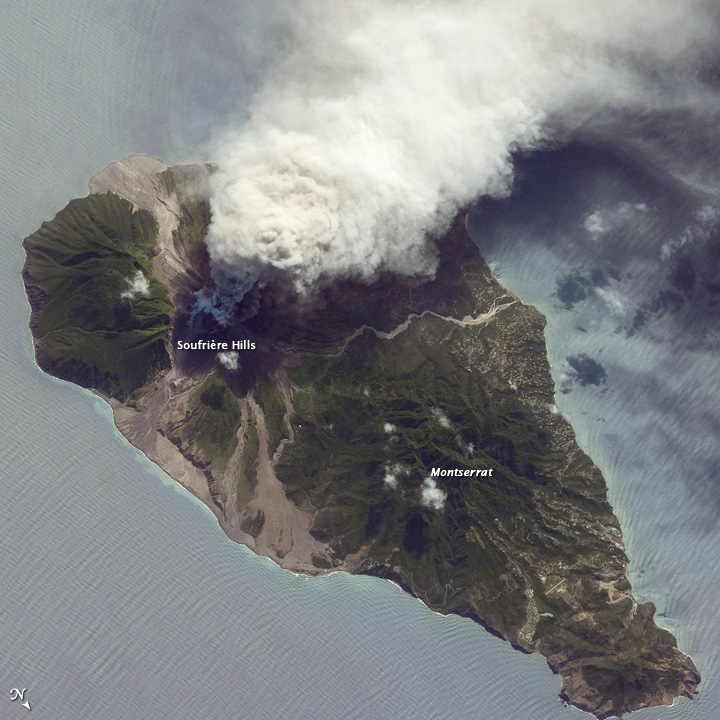
On November 4, the National Disaster Preparedness and Advisory Committee reduced the hazard level from 3 to 2, which allows day-time access to Zone C – an area considered relatively safe to travel when hazard is lower. The Montserrat Volcano Observatory advised that the volcano is in a continued state of pause which is now the longest since the eruption began in 1995. The current pause began on February 11, 2010, when the dome collapsed. There has been a continued decrease in rock fall and pyroclastic flows since that time. The previous longest pause (625 days) occurred between 1998 and 1999.

The Soufriere Hills volcano covers the southern half of Montserrat, a small island in the West Indies. Its first historic eruption started in 1995 and is still ongoing. By late 1997 pyroclastic flows and hot ash had destroyed nearly 80% of the capital city, Plymouth. Once home to 4,000 people and the seat of government and business, the town was buried under 1.4 meters (4.6 feet) of ash and was abandoned. The entire southern half of the island was declared an “exclusion zone”, because of the dangers of the ongoing eruptions and the government of the island was moved to Brades.

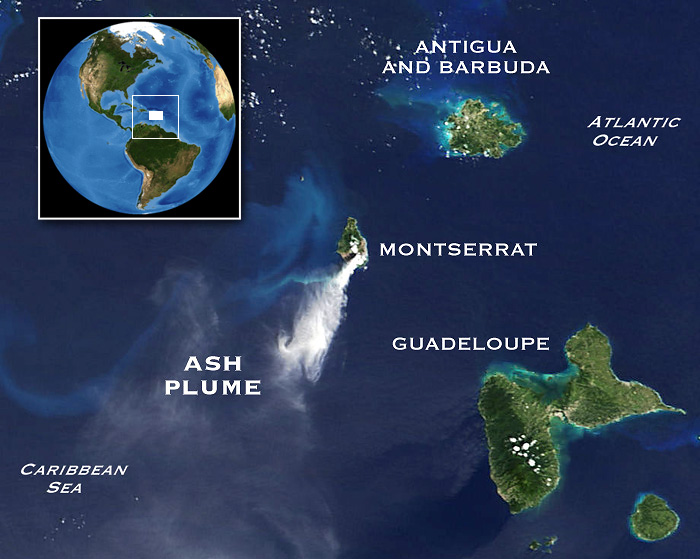
Ash from Soufriere Hills was blowing away from neighboring islands when this image was taken by NASA's Terra satellite (Credit: EarthWeek)

The long-term eruption of Soufriere Hills has consisted of small-to-moderate ash eruptions accompanied by lava-dome growth and pyroclastic flows. Reportedly, non-eruptive seismic events, termed “failed eruptions” had occurred at Soufriere Hills volcano in the 1890′s, 1930′s, and 1960′s. However, except for an eruption around 1630 AD that produced the Castle Peak lava dome, no eruptions other than the current one have been witnessed on Montserrat. (MODIS)

-

Cornwall coastguards in new island warning

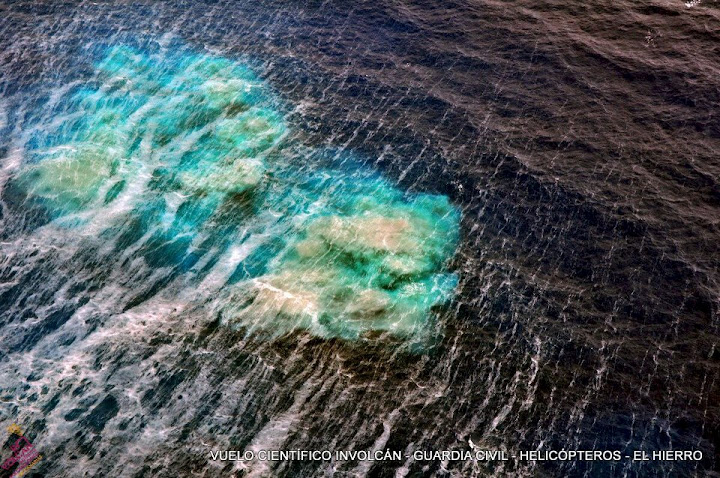
Coastguards in Cornwall have had to issue warnings to sailors to inform them that a new island has appeared in the Canary Islands.

The island has been formed by molten lava pushing up from the seabed.

Falmouth Coastguard, which deals with incidents in the Atlantic, said it confirmed the new island with coastguards in Spain.

Richie Williams, from Falmouth Coastguard, said they were passing on warnings from the Spanish.

He said: "They've issued a navigation warning to this effect and have put a four nautical mile cordon around that area

"Vessels are being advised to take extreme caution when approaching."

- - -